Mise à jour
Mise à jour de la base de données, veuillez patienter...
source: Free Software Foundation Europe
The Cyber Resilience Act has been in force for over a year. However, there are still uncertainties and recurring questions. During FOSDEM 2026, the FSFE held a Q&A session on this topic together with a representative of the German market surveillance authority and the European Commission.
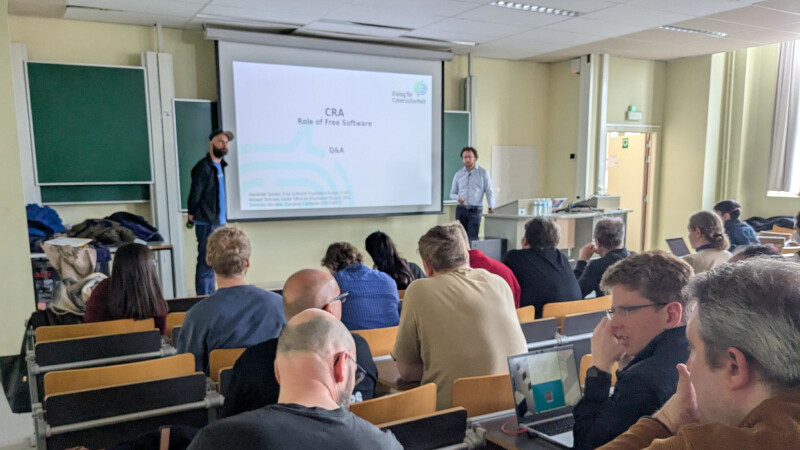
One question, that we also explored in a survey, is the role of the steward. People are still unsure whether and under what circumstances they should or want to become a steward. One part of the question is relatively easy to answer: no one has to become a steward. The Cyber Resilience Act (CRA) is a product regulation that aims to place obligations on manufacturers. As long as you are not a manufacturer and your software is not incorporated into a product, the CRA does not apply to you. It becomes more complex if you develop Free Software that is used in products. In this case, the manufacturer must ensure that they can fulfil the obligations under the CRA. If the manufacturer decides to use your project, you may consider whether you would like to become a steward. If you do not want to become a steward, the manufacturer should look for alternatives or, for example, fork your project so that they can fulfil the obligations under the CRA. However, they cannot force you to become a steward.
This gives you the opportunity to work with the manufacturer and be compensated for working on your Free Software.
Besides the option of becoming a steward, there is also the option of attestation (Art. 25 CRA). In order to facilitate the due diligence obligation, voluntary security attestation programmes could be established. This could also be an interesting option for you to help ensure the maintenance of your software is sustained in the long run. There is still uncertainty about attestation, which is to be clarified by a delegated act of the European Commission. For this purpose, we have launched another survey, and you are welcome to participate by 28 February 2026, midnight AoE. to contribute your ideas and suggestions.
We will evaluate the results and make them available to decision-makers and relevant stakeholders, incorporating them into the process. Here, too, we will focus our efforts on ensuring that Free Software contributors and small projects are protected and supported.
Resources:
For more than a decade, the Free Software Foundation Europe has worked to protect Router Freedom in Europe. The European Union is about to reform the telecom sector with the proposed Digital Networks Act. We call for a clear and harmonised approach that upholds this freedom across all Member States
Router Freedom is the right of users to choose and operate their own routers / modems and other equipment used for internet connection. It is important for user autonomy, competition, and privacy as it would enable users to run Free Software operating systems on their routers and modems of choice. Router Freedom is understood in a broader context as a crucial element of Device Neutrality, and it requires that network operators must allow end-users to run Free Software on their devices.
For over ten years, the Free Software Foundation Europe (FSFE) has been successfully advocating for this freedom across Europe with successes in Finland, Germany, Italy, the Netherlands, Greece, and Belgium.
The proposed Digital Networks Act (DNA) aims to reform the telecommunications sector in the European Union (EU). In the previous iteration (2018-2020) of regulation of routers, the EU introduced several technical rules that fragmented the implementation of Router Freedom by allowing national regulators to exclude this right from determined network topologies when “objective necessities” were in place. Unfortunately, many member states used this opportunity to exclude Router Freedom from fibre networks. Now, the DNA presents an opportunity to close this fragmentation gap by securing Router Freedom in a consistent and effective manner across the European Union.
Router Freedom is formally recognised in EU law; however, the practical implementation depends largely on how the Network Termination Point (NTP) is defined. The NTP marks the boundary between the provider’s network and the user’s terminal equipment. If this point is defined, for example, behind a provider-supplied router, users are effectively prevented from using their own devices, even if Router Freedom is nominally guaranteed. For Router Freedom, ensuring that the NTP is clearly defined at the appropriate access point is therefore essential.
Only the designation of the NTP at the passive physical point where the public network connects to the end-user's premises guarantees Router Freedom for all European users.

Although BEREC, the European telecom regulatory body, issued guidelines setting Router Freedom as the default for all network topologies, it allowed national authorities to set exclusions. Recent examples illustrate this fragmentation. In Austria, regulatory decisions have weakened Router Freedom by allowing interpretations of the NTP that restrict users’ ability to replace provider-supplied routers. In Italy, the regulatory framework has shifted back and forth over time, creating uncertainty and instability for users, manufacturers, and internet service providers (ISPs). These divergent approaches show that non-binding guidance alone has not been sufficient to ensure consistent protection of Router Freedom across the EU.
This fragmentation of rules across member states has led to limited oversight on how ISPs treat customers who use their own equipment for internet connection. In the most comprehensive study the FSFE has conducted to date, the following issues were identified:
Security issues. The lack of Router Freedom generates negative consequences for network security. Some ISPs do not provide security updates for their devices. When end-users cannot manage their own routers, they become more exposed to security flaws.
This situation undermines not only user rights, but also the internal market of the EU. If you pay the electricity to power your router, it should be as much under your control as your own coffee machine or laptop, not something dictated by your internet provider. Different national rules on where the network ends and the user’s equipment begins create barriers for device manufacturers, complicate cross-border offerings, and erode trust in EU-level protections.
The position of the FSFE is that the Digital Networks Act (DNA) must move beyond fragmented national rules and establish a clear, operational framework ensuring effective and uniform protection of Router Freedom. This requires setting a harmonised default across the EU that properly reflects the interests of end-users and consumers. Any deviation due to network topology should remain the exception, not the rule, and must be transparently justified.
Several regulators have already supported this approach. Germany’s national authority has rejected many of the arguments raised by internet service providers against Router Freedom, confirming users’ right to choose their own terminal equipment in fibre networks as well. Similarly, in 2023, Belgium formally introduced Router Freedom covering all network types, including fibre. Finland implemented Router Freedom as early as 2014 and reaffirmed its commitment in 2021. In the same year, the Dutch Authority for Consumers and Markets published rules confirming Router Freedom for consumers in the Netherlands.
In order to protect Router Freedom and make sure that a harmonised approach across the EU is implemented, amendments in Recital 14, Article 69, and Article 125 of the proposed text are necessary. The changes are needed to consolidate the identification of the NTP at the passive physical point of the network, by default.
"With the upcoming legislative discussions on the Digital Networks Act, we call on EU policymakers to establish Router Freedom as a clear and enforceable principle across the Union, guaranteeing all European consumers the right to use their own terminal equipment, no matter the network topology, and putting a definitive end to regulatory fragmentation", states Lucas Lasota, FSFE's Legal Programme Manager
Today, we have submitted our position on Router Freedom to the European Commission’s consultation on the Digital Networks Act. You can read it here.
The engagement of the FSFE in European and national policy processes requires sustained effort, including participation in meetings, consultations, and in-person discussions with policymakers and regulators across Europe. If you value Router Freedom and want to support our work, please make a donation. Your contributions help cover essential costs such as travel and coordination, enabling the FSFE to continue advocating effectively for users’ rights in the Digital Networks Act and beyond.
Become an FSFE supporter now!
Happy I Love Free Software Day! And with this we have a special Software Freedom Podcast episode to mark this special day with something nice. For our I Love Free Software Day podcast episode we have spoken with Lorenz Kästle from the monitoring plugins.
Lorenz is part of the maintainers team that keep this core infrastructure, which is not a frontend software project, up and running. In this episode Bonnie and Lorenz discuss what nice benefits but also challenges come along with being a maintainer in your free time.
Let us celebrate all contributors and maintainers of Free Software on the 14th of February and throughout the year! For the I Love Free Software Day 2026, we say a big thank you to all the amazing software maintainers out there.
The FSFE's work aims at safeguarding Software Freedom. You can support our work by donating today!
Show notes
We are happy to receive your feedback on the Software Freedom Podcast and especially on the transcript of the episode. Please, email us to: podcast@fsfe.org. If you liked this episode and want to support our continuous work for software freedom, please help us with a donation.
In this 46th episode of the Software Freedom Podcast, Lucas Lasota and Bonnie Mehring go into interoperability compliance under the EU’s Digital Markets Act (DMA) and mobile phones. The podcast dives deeper in the compliance changes in Android Open Source Project (AOSP).
Recorded at FOSDEM, this episode with Bonnie and Lucas dives into why phone interoperability under the EU’s Digital Markets Act still feels like unfinished business. Article 6(7) is supposed to force big platform “gatekeepers” to open up the same hardware and software features they use themselves, making it easier for alternative apps and services to compete. But the reality for developers is far messier.
In this episode, we unpack how Android developers have been facing hurdles to get interoperability information within AOSP and why a developer-friendly enforcement is crucial for the future of digital markets in Europe.
The FSFE's policy work is an important part of our aim to safeguard Software Freedom. You can support our work by donating today!
Show notes
We are happy to receive your feedback on the Software Freedom Podcast and especially on the transcript of the episode. Please, send us an email to: podcast@fsfe.org. If you liked this episode and want to support our continuous work for software freedom, please help us with a donation.
February is a reminder of why our Free Software community matters and why it's such a joy to be part of it. After FOSDEM, we are now looking ahead to the celebrations of the I Love Free Software Day across Europe. We are also catching up with our latest episodes of the Software Freedom Podcast focused on European policy and a Legal Corner about the freedom to study source code.
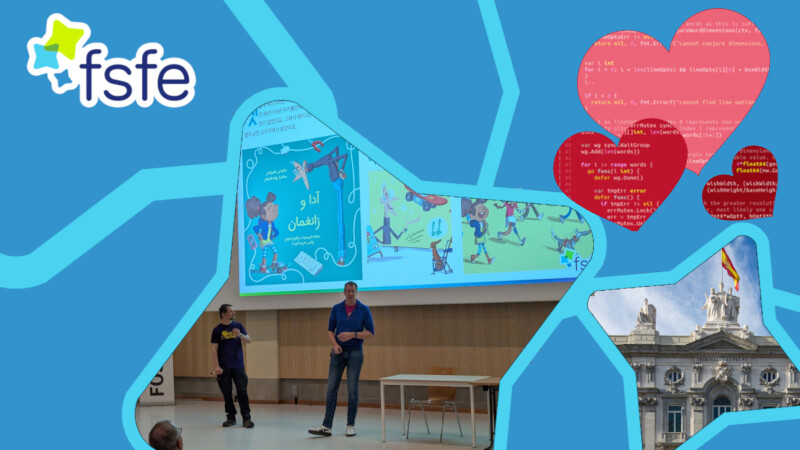
It all started in Brussels, at FOSDEM. As always, the weekend was intense, inspiring, and full of familiar and new faces. Our booth quickly became a place to stop, chat, and exchange ideas while getting your hands on our newest merchandise: two new T-shirts (cool kids and PMPC!) and a new design of our ilovefs red socks! -remember you can get all the merchandise at our website-. Connecting with so many people in person, hearing your stories, and feeling the shared energy around Free Software was a real highlight for us.
FOSDEM is also an important opportunity for us to present and discuss our work. Once again this year, the FSFE was among the organisers of the Legal & Policy Issues Devroom. The day opened with Gabriel's talk, "An Introduction to Law and Free Software", which set the stage for a series of engaging discussions. Among them, Alex, together with Michael Schuster and Tommaso Bernabo, addressed the role of Free Software in the Cyber Resilience Act. This was followed by a lively Q&A with the audience. Later that day, Lucas led a panel discussion on Interoperability regulation in the EU, joined by representatives from the European Commission and the Data Rights organisation.
During FOSDEM, we launched a new survey to collect input on how voluntary security attestation programmes for Free Software could be designed under Article 25 of the Cyber Resilience Act. The survey contains 27 questions, but participants are not required to answer all of them. We welcome feedback until the end of February. Take part in the survey!
As in previous years, the Legal & Policy Devroom attracted significant interest, with highly engaging topics and thoughtful questions from attendees. We would like to thank our co-organisers Karen Sandler, Tom Marble, Bradley M. Kühn, and Richard Fontana for helping make this Devroom happen. It is truly a pleasure to organise it together with all of you.
Besides this Devroom, and in addition to co-organising two others (Funding the Free Software Ecosystem and Free Software Mobile), several FSFE staffers were also busy participating in other Devrooms. Tobias was invited to speak about Friendica in the Social Web Devroom, while Bonnie and Sofía presented our European coding competition for teenagers, YH4F, which is currently in its programming period (registration is still possible!). Besides, Bonnie together with our volunteer Øjvind, introduced the audience to podcasting with Free Software, as part of the Audio, Video & Graphics Creation Devroom. They also seized the opportunity to record a live episode at FOSDEM, which we can't wait to publish soon!
Speaking of podcasts, in the busy weeks leading up to FOSDEM we released two episodes of the Software Freedom Podcast focused on European policy: one offering an overview of the most relevant current EU initiatives affecting Free Software, and another covering the latest news on the RED directive.
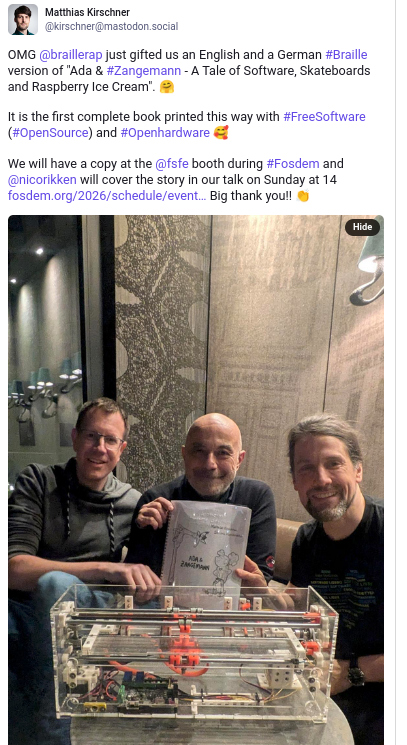
Back in Brussels, we also received exciting news about Ada & Zangemann! Matthias and our volunteer Nico participated in the FOSDEM main track with a talk on automating the translation of a bestseller to spark children's interest in coding. For the first time, the Dutch version of the book was available for purchase at our stand! Thanks to Nico, who put in a lot of work, for making it possible! Moreover, our volunteer Stephane produced several copies in English and German using a homemade Braille printing device. If you know anyone who is visually impaired, please get in touch with us!
Meanwhile, more volunteers, this time in December in Denmark, sent a letter to a Danish parliamentary commission regarding the implementation of the digital wallet. The FSFE local group participated in a follow-up, which was ultimately submitted by IT-Politisk Forening, a local association better equipped to provide input on Danish policy issues. This prompted numerous questions to the Minister about why the upcoming digital wallet is not fully Free Software, as such solutions must be.
We also come with news from Spain. The newest Legal Corner article focuses on a September 2025 ruling from the Spanish Supreme Court, that provides a legal precedent and underlines the importance of transparency in source code and algorithms, and support for the freedom to study! When public authorities in Spain use algorithms, in decision-making that affects citizens, they are obliged to allow citizens to understand how the algorithms work.
While all of this has been happening, we have also been busy preparing for something very close to our hearts: I Love Free Software Day, which is coming up this week. We are getting ready to celebrate Free Software and the people behind it: developers, activists, translators, designers, and supporters who make this movement what it is, across Europe.
This year, we shine a spotlight on Free Software maintainers, the dedicated individuals who ensure Free Software projects stay available, functional, and up-to-date across systems. Their work is essential for all of us who rely on Free Software every day. Maintaining packages is often time- and resource-intensive, requiring powerful systems to build, test, and troubleshoot them.
With I Love Free Software Day 2026, we celebrate their commitment, expertise, and passion that keep the Free Software ecosystem thriving. Let’s recognise their efforts and say a heartfelt thank you to all maintainers!
We want to send a huge THANK YOU to everyone supporting us, including our amazing donors! We may be behind the wheel, but you are the ones keeping us moving forward. You can also support us, contribute to our work, and join our community. Are you using social media? If so, do not forget to follow us there! You can also follow the FSFE news in your <a href="/news/news.rss">RSS Reader</a>
Your editor, Ana